I’m sitting in a sliver of morning light an hour after sunrise on the best day of the Islamic year: the Day of Arafah, when pilgrims gather on an open plain near Makkah for the most important few hours of their lives. That period – later today – is called ‘wuqoof’, and it’s the climax of the Hajj, when pilgrims stand (or sit) pouring their hearts and souls out in supplication, during what is the spiritual peak of their lives.
Inside the house, scenes from Arafah are live on the TV. Scholars discuss the virtues of the day. Others talk about their experiences there. Everyone focuses on the activities of this immense, once-a-year event. For most Muslims, it’s a once-in-a-lifetime event.
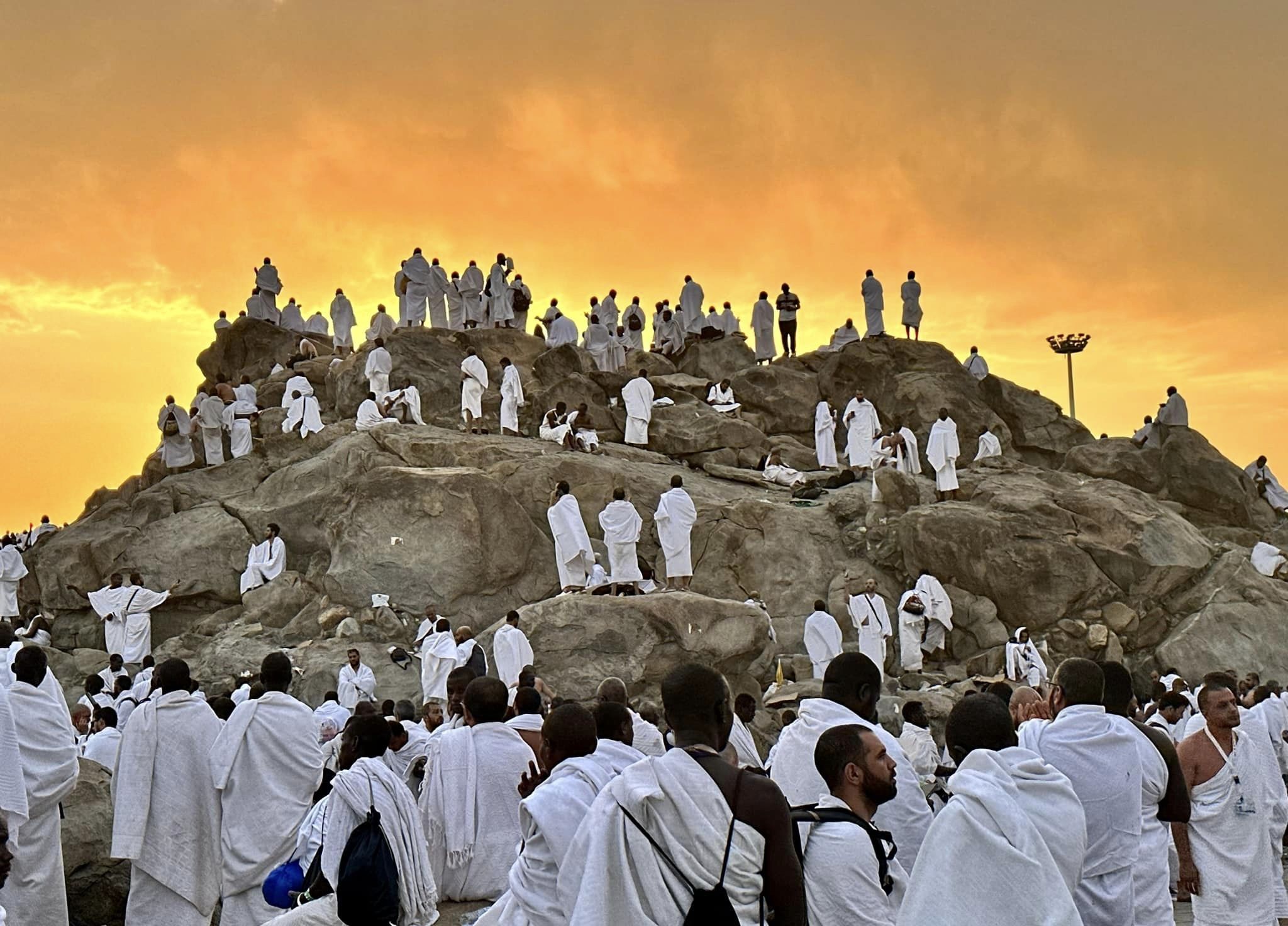
We were blessed to be there 14 years ago, on this very day…my wife and I. And I was reflecting on my memories of the trip, and that day. And I was thinking of how I somehow believed that I would get back there for Hajj at some point in my future life. It didn’t seem that far-fetched at the time. You would register for Hajj in the year before you wanted to go, and hope you made it to the list of accredited pilgrims for the following year. First come, first served. No fuss.
Right after our Hajj, the system changed, driven by a reduction in quota. South Africa can now only send 2500 pilgrims each year. Registration is now open all the time – so thousands upon thousands populate the ever-growing registration list, but you only get selected when you reach high enough in the list. At the moment, from first registration, your wait is anything from 15 years or more, unless you are able to jump the queue because of special circumstances. And if you have already gone, you are disadvantaged because you lose accreditation points. Obviously, the system is designed to favour first-timers – as it should be.
If I were to register again now, I might only make it back in my 60s or 70s – assuming I live that long. By that time, my body may no longer be able to manage such a rigorous endeavour – as it did when I was still young. Or if it could, I certainly wouldn’t be able to make the most of it because of the physical limitations that come with age.
Already, in my mid-40s, this body is already prone to bouts of multiple issues at a time. I don’t want to imagine how the steady degeneration over the coming years and decades will deepen those episodes.
At this point, I’ve sort of reached the conclusion that I probably won’t make it back for Hajj again. It’s not just the physical aspect. Nor the financial considerations (Hajj costs rose dramatically in the pandemic period, and have remained high ever since).
I just don’t feel like it’ll happen. I previously believed that the phrase “once-in-a-lifetime” was simply used as a superlative to describe the honour of the Hajj experience. I didn’t take it literally back then. But now, it does feel literal.
Decades ago, there were no restrictions. People could go every year if they wanted. Many did. But those days are long, long gone. And it makes sense that things were always heading towards restrictions. There are around 2 billion Muslims in the world now, but the Hajj can only accommodate 2 to 3 million each year. The authorities have been building up the facilities in the hopes of reaching 5 million, but even if this is reached, it’s still a drop in the ocean. Hajj quotas have to be enforced because the demand will always far outweigh capacity.
And so, realistically, I don’t see it as a possibility. I still hold hope, of course, but no expectations.
And I think that’s OK. I recognise how extremely privileged I am to have even gone in the first place. It’s a journey that most will never get to make in their lifetimes, and to have done it once is an honour.
So, I feel immensely grateful.
I think what has changed over the years is my thinking around post-Hajj life. In the past, I expected that Hajj would be this life-changing journey, and after it, I would strive to be the best person I could – always trying to build higher and higher.
But nowadays, I no longer hold myself to such expectations.
And it’s not that I’ve dropped my standards after realising that those standards turned out to be unrealistically high.
It’s that I realised that life isn’t linear. It’s a winding journey with twists, brick walls, and unexpected turns. Challenges can be harder than you expect. They can last far longer than you hope they will. They can be more traumatising. The pressure can be more intense than you think you can handle, for prolonged periods.
There will be highs and lows, and periods of stagnancy, and everything in between.
You cannot set expectations for your entire life at one age and hold them as the goal until you die. Instead, you have to recognise that life is full of moving parts, and every new period marks a different stage in your ongoing evolution.
You are always becoming, but you never become.
So it’s best to set broad goals – an overall framework of who and what you want to be by the time your life expires – but allow great flexibility within that. And just always keep trying* to fulfil those ambitions, without expecting you will ever get there.
* I don’t say “try your best” – because there are times where motivation and willpower are low, and piling the pressure on yourself is counter-productive. But just try. Consistently, and in small pieces if necessary.
Image source: Esa Alexander (2024)
 slip-sliding away.....
It seems, Yacoob, that you honor your memory of the Day of Arafah by sharing both it and your adjustment to the fact that you may not experience its holy physicality again. But that sacred day and its blessings, though lived once, continue to bless your perceptions and actions as you gain wisdom and make life choices. You voice understanding about your life that you didn’t have 14 years ago, but surely that day’s light and spiritual gifts guided you along the path to the words you now write.
Thank you for sharing all of this. You inspire me!
Thanks, Kitty. I certainly didn’t think of it as a source of continuing blessings, so you’ve given me something to think about
It’s good that you made the journey at least once, which seems like quite the accomplishment. I’m sure the experience has enriched and will continue to enrich your life in numerous ways.